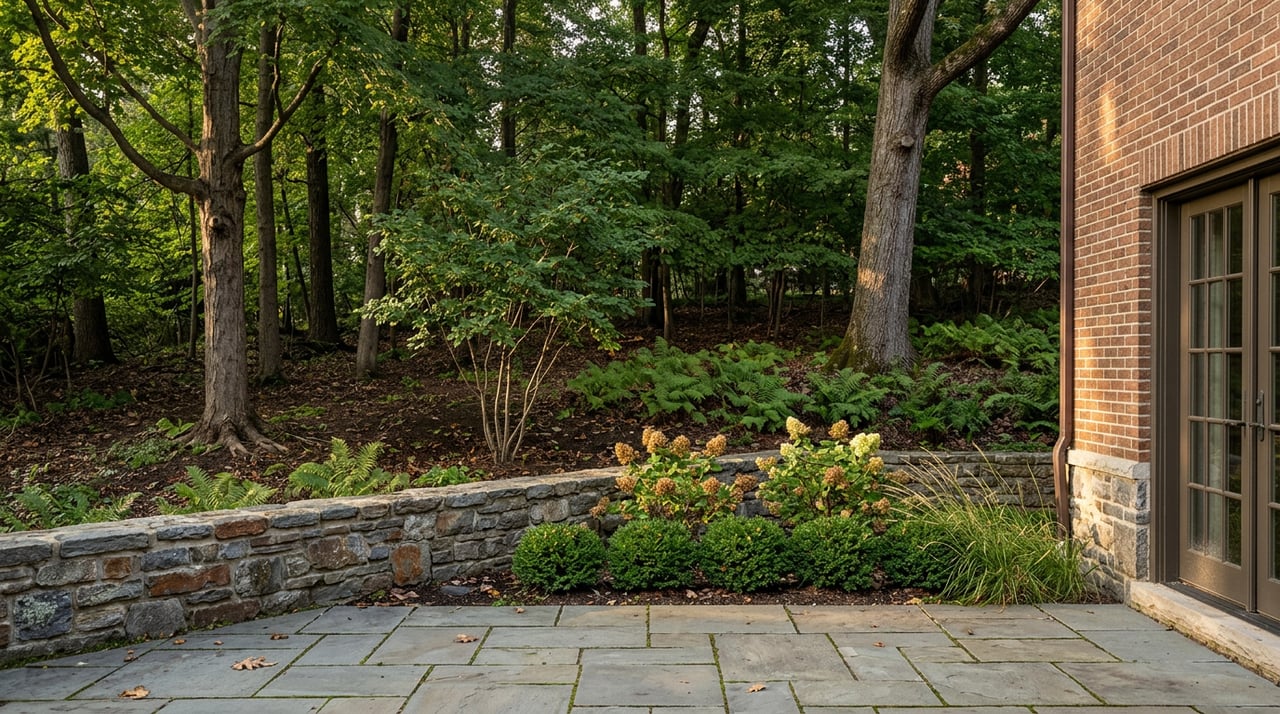
The listing photo shows towering oaks, a slice of blue water through the trees, and a lot that feels more like private acreage than a suburban address. What the photo does not show is that the ravine running through that lot is doing more legal work than the house sitting on it. In Lake Forest, a wooded or bluff-adjacent property comes with its own layer of due diligence, one that has nothing to do with square footage or finishes and everything to do with what the ground underneath is allowed to do, and what you are required to say about it later.
That layer is not hypothetical. It shapes what you can build, what a seller has to disclose, and how long a stabilization project can take before you're even allowed to start.
The lot has its own rulebook
Lake Forest has nearly 13 miles of ravines within city limits, and almost all of them are privately owned, with property lines often running straight down the center at the bottom of the ravine rather than stopping at its edge, according to the city's own resident brochure on ravine and bluff care. The city also carries about 3.5 miles of Lake Michigan frontage. Neither of those numbers shows up on a listing sheet, but they explain why so many due-diligence conversations in this market start with a plat of survey instead of a comp.
Illinois does not help by setting a statewide answer. There is no statewide bluff setback in the state, according to a regional shoreline law review from the National Sea Grant Law Center, which leaves setback distances, construction limits, and grading rules to individual municipalities. In Lake Forest, that means the city's own Building Review Board, and its Code, become the real authority a ravine-lot buyer needs to understand.
East and west are two different due-diligence conversations
Lake Forest was platted in 1857 as a planned community built around its ravines and bluffs rather than a street grid, and that founding decision still splits the city into two distinct property profiles today. A local waterproofing contractor who has worked across the city for decades lays out the divide this way, and the pattern holds up against the geography: everything east of Green Bay Road, along and near the lake, sits on bluff-adjacent terrain with active ravine systems and foundations dating from the 1870s through the early 20th century, while the sections developed from the 1950s through the 1980s further west sit on flatter ground with more conventional poured-concrete foundations, according to U.S. Waterproofing's overview of Lake Forest's foundation conditions.
That divide matters more than curb appeal. A home a few blocks from the lake or a ravine corridor faces a different due-diligence checklist than a home of the same era and price a mile west of it.
| Eastern Lake Forest (bluff and ravine adjacent) | Western Lake Forest | |
|---|---|---|
| Typical era | 1870s to early 1900s estate-era construction | 1950s to 1980s postwar development |
| Terrain | Steep ravine corridors, lake bluff | Flat to gently sloping |
| Foundation type | Stone, brick, and early concrete | Poured concrete |
| Design review trigger | Ravine setback and Building Review Board review common | Standard permit review in most cases |
The setback question has a real answer, and it isn't always where you'd guess
Setback distances on ravine lots get decided case by case, and the city's own Building Review Board minutes show how specific that can get. At a 2019 hearing on a proposed residence on Turicum Road, city staff confirmed a 20-foot ravine setback applied to that particular property, and clarified that maintenance responsibility for the ravine itself depends on where the property line actually falls. In some cases it belongs to the private owner. In others, the city or the Lake Forest Open Lands Association is responsible, according to the Building Review Board's own meeting record.
That last detail is easy to miss and worth confirming before an offer goes in. Two neighboring ravine lots can have completely different answers to "who is responsible for that slope," and the answer changes what a buyer is actually taking on.
Once a project is underway, the city's design standards require that construction preserve the natural grade of the site to protect drainage patterns, and any exterior project reviewed by the Building Review Board needs architectural plans stamped by an Illinois-registered architect, per the city's own municipal code. That single requirement adds a professional-fee line item that flatter, non-ravine lots in western Lake Forest typically skip.
What the state disclosure form actually asks about ground stability
Every seller of a one-to-four-unit residential property in Illinois has to complete a standard Residential Real Property Disclosure Report before a contract is signed, a requirement that has been law since 1998 under 765 ILCS 77, according to a law firm's overview of the Act. The form asks roughly 22 to 23 yes-no-not-applicable questions covering everything from the roof to the wiring, but two of them carry particular weight on a ravine or bluff lot: whether there has been flooding or leakage in the basement or crawlspace, and whether there is settlement or earth instability, according to that same breakdown of the form's line items.
Sellers are not required to hire an engineer or proactively test the ground before answering. The law only requires them to disclose what they actually know, according to a legal overview of the Act's inspection standard. That means the disclosure form is a starting point, not a substitute for a buyer's own inspection on a sloped or ravine-edge lot, especially given how much history some of these ravines carry.
The erosion is not theoretical
On the city's own shoreline, the Lake Forest Open Lands Association began a $5.75 million restoration project this year at the 61-acre Greene Nature Preserve, funded through a NOAA coastal management grant awarded in partnership with the Illinois Department of Natural Resources, as reported by the Daily Herald in January 2026. The preserve's bluff, part of what was once the McCormick family's Gilded Age estate, has lost significant ground to wave action and high lake levels in recent years.
"A solid 15 feet of bluff and all vegetation."
That's how Ryan London, president and CEO of Lake Forest Open Lands Association, described what the preserve lost during the high lake levels of 2020, in a February 2026 interview with WTTW. The restoration work, which was set to begin that spring, is expected to wrap by fall 2027, with the organization moving into a monitoring phase by 2028. It is a public example of a private problem that plenty of Lake Forest bluff owners manage quietly, without a federal grant behind them.
Stabilization is a permitted project, not a weekend fix
When a property owner does need to stabilize a bluff, the work looks nothing like a typical home renovation timeline. One completed project on Lake Road involved installing 17 wick drains to pull internal water out of the bluff, followed by a quartzite stone revetment at the base to protect against wave action, according to the marine contractor who completed the work.
Before any of that work can begin, the Illinois Department of Natural Resources has to issue a shore protection permit, a process that includes public notice and a 30-day comment period, with no construction allowed to start until the permit is in hand, according to a summary of Illinois shoreline permitting rules. A buyer who assumes a bluff issue can be handled the way a roof or a furnace gets handled, on the seller's timeline before closing, is usually working with the wrong calendar.
The real question to ask before you write the offer
The house on a ravine lot is often the easy part of the decision. The harder part is confirming what the ravine itself allows, who is responsible for maintaining it, what the seller actually knows and has disclosed about its stability, and how long any future work on it might take to permit. None of that shows up in a median price, and most of it is easy to overlook when the view is doing all the talking.
If you're weighing a ravine or lakefront property in Lake Forest and want a second set of eyes on the setback, the disclosure form, or the history behind a particular lot, Dana Pierson-Emering has spent two decades working this exact stretch of the North Shore and can walk through what a specific property's paperwork actually says before you commit to it. Let's connect and start your search or get a personalized home valuation.
Frequently Asked Questions
Does every ravine-adjacent home in Lake Forest need Building Review Board approval? Not for every project. Review is generally triggered by new construction, additions, or any change that affects the exterior appearance of a property, particularly one within a ravine setback. Confirming the specific trigger for a given lot with the city is worth doing before assuming a renovation can move forward on a standard permit timeline.
Do sellers have to tell me if a ravine or bluff has eroded on their property? If they know about it, yes. The state's Residential Real Property Disclosure Report specifically asks about settlement or earth instability and about flooding history, and sellers are required to answer based on their actual knowledge at the time of disclosure.
Is there a typical cost for bluff stabilization in Lake Forest? There isn't a standard figure, since every ravine and bluff situation is different in scope and permitting requirements. The Lake Road project's combination of wick drains and a stone revetment is one real example of what a stabilization project can involve, but the right approach for any given lot depends on its own soil and slope conditions.